

Supreme Roofing specializes in commercial roofing. We are an award-winning commercial roofing...
Severe weather now threatens more than 25 percent of U.S. properties, representing over $12 trillion in property value, underscoring how widespread and financially significant weather-related damage has become for buildings across the country.
That said, wind damage to flat commercial roofs is often misunderstood and frequently overlooked.
Unlike hail or obvious impact damage, wind-related issues do not always leave dramatic visual clues.
In many cases, damage develops quietly, worsening over time until leaks, insulation failure, or system-wide deterioration force emergency action.
For property managers and building owners, the risk is not just the wind event itself.
The greater risk is failing to recognize early warning signs before minor damage escalates into costly disruption.
This guide explains how wind damages flat commercial roofing systems, what warning signs to look for, and when professional evaluation becomes necessary.
This is not a checklist for climbing onto your roof.
It is a framework to help you understand risk and make informed decisions.
Why Wind Damage Is Different on Flat Commercial Roofs
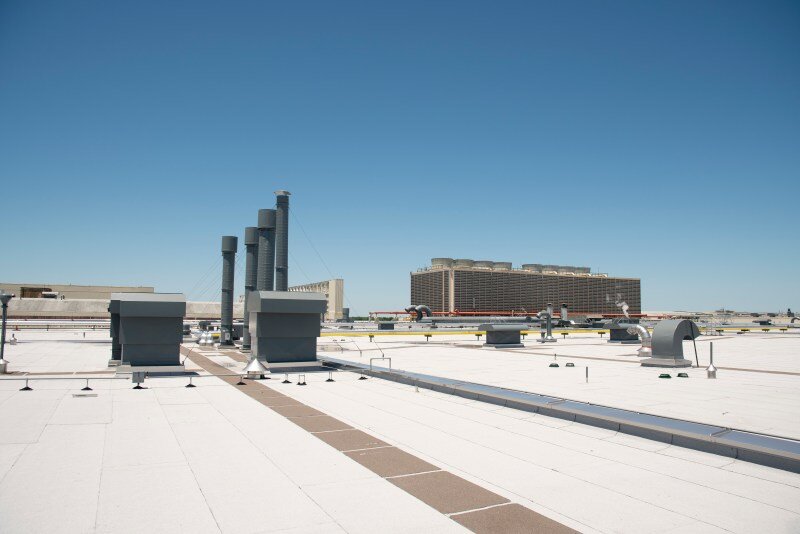
Flat and low-slope commercial roofs behave very differently than steep-slope residential systems.
Rather than tearing materials away immediately, wind often:
- Creates uplift pressure at seams and edges
- Stresses flashings and penetrations
- Loosens fasteners and adhesives
- Allows moisture intrusion without obvious surface damage
Wind damage rarely happens all at once. It accumulates.
Once wind compromises a section of the roofing system, water intrusion and insulation saturation often follow, accelerating failure well beyond what is visible from the surface.
How Wind Actually Damages Flat Commercial Roofing Systems
Understanding the mechanics matters.
Wind creates negative pressure that lifts roofing materials upward rather than pushing them down. This uplift force is strongest at:
- Roof perimeters
- Corners
- Parapet walls
- Penetrations and transitions
Over time, repeated wind events can weaken seams, adhesives, and attachment points.
Even moderate winds can cause damage if the system is aging or was improperly installed.
Sign 1: Loose or Lifted Membrane Edges
One of the most common indicators of wind damage is membrane movement.
Look for:
- Edges that appear curled or lifted
- Wrinkles or ripples near roof perimeters
- Sections that no longer lie flat
These conditions often indicate uplift stress that has weakened adhesion or fastening. Once edges are compromised, wind can continue working underneath the membrane, expanding the affected area.
Sign 2: Damaged or Displaced Flashing
Flashings are among the most vulnerable components during wind events.
Warning signs include:
- Bent or missing metal flashing
- Separated membrane flashing at walls or curbs
- Cracked sealant around penetrations
Flashing failure allows wind-driven rain to enter the roofing system, often without immediate interior signs. Left unaddressed, these openings frequently lead to leaks and insulation damage.
Sign 3: Punctures or Tears Near Roof Features
Wind does not act alone.
Debris lifted by wind often becomes the source of roof punctures or abrasions. Common impact zones include areas near:
- HVAC units
- Pipe penetrations
- Skylights
- Drainage components
Even small punctures can allow moisture to enter the system. On flat roofs, water can travel laterally beneath the membrane, spreading damage far beyond the original entry point.
Sign 4: Ballast Displacement on Ballasted Roofs
For ballasted roofing systems, wind damage may appear as movement rather than material failure.
Indicators include:
- Uneven gravel distribution
- Exposed membrane areas
- Ballast piled against parapet walls
Ballast displacement reduces the system’s ability to resist uplift and exposes the membrane to UV and physical damage. Once ballast shifts, the roof becomes increasingly vulnerable to future wind events.
Sign 5: Interior Leaks or Water Staining After Wind Events
Interior symptoms often lag behind roof damage.
Be alert for:
- New ceiling stains
- Water intrusion near exterior walls
- Moisture following storms without heavy rainfall
Wind-driven rain can enter compromised areas that remain watertight during normal conditions. When leaks appear only after windy storms, wind damage is often the underlying cause.
Sign 6: Changes in Roof Drainage Patterns
Wind damage can subtly alter drainage behavior.
Watch for:
- Ponding water where none existed before
- Slower drainage after storms
- Overflowing drains during moderate rainfall
These changes may indicate membrane displacement, insulation compression, or structural movement caused by repeated wind stress.
Sign 7: Increased Repair Frequency After Storms
Repair history tells a story.
If service calls become more frequent after wind events, even when repairs seem minor, that trend matters. Repeated seam failures, flashing repairs, or localized leaks often signal broader system fatigue rather than isolated defects.
At a certain point, repairs stop reducing risk and begin delaying a larger issue.
Why Wind Damage Often Goes Undetected
Many wind-related failures occur beneath the surface.
Moisture trapped under a membrane:
- Reduces insulation performance
- Accelerates material breakdown
- Weakens attachment systems
- Increases long-term repair costs
By the time surface damage becomes obvious, system-wide deterioration may already be underway.
This is why visual observation alone is rarely sufficient.
When Professional Evaluation Is Necessary
After significant wind events, professional evaluation is strongly recommended when:
- The roof is mid-life or older
- Repairs have been increasing
- Warranties are in place
- The building is occupied or operationally sensitive
A proper assessment examines:
- Membrane integrity
- Seam and flashing conditions
- Insulation moisture levels
- Attachment performance
Book a complimentary roof assessment today: https://landing.supremeroofing.com/free-roof-assessment
How Wind Damage Affects Warranties
Many commercial roof warranties require:
- Prompt reporting of storm damage
- Documentation of inspections
- Repairs completed to manufacturer standards
Undetected or undocumented wind damage can jeopardize warranty coverage. Regular inspections and proper reporting protect both the roof and the building owner.
Key Takeaways for Flat Commercial Roof Wind Damage
-Wind damage is often progressive, not immediate
-Flat roofs are vulnerable at edges, seams, and penetrations
-Interior leaks may lag behind roof failure
-Repair trends reveal more than isolated issues
-Early evaluation reduces long-term cost and disruption
Talk With Craig Rainey 1:1
I have spent decades helping building owners and property managers evaluate roof damage after wind events and understand when minor issues require attention and when larger risks are developing.
The goal is not to overreact to every storm.
It is to recognize when wind damage is compromising system performance and creating avoidable risk.
If you are unsure whether recent wind events may have affected your flat commercial roof, or how to interpret repair patterns, I would be happy to talk with you. A one-on-one conversation can help clarify what you are seeing and determine the smartest next steps before small issues escalate.
Schedule a 1:1 meeting with me here:
https://landing.supremeroofing.com/meeting-with-craig-rainey